

OLED screen and LCD screen which is better
Source: Driving China Text: Wu Hai Yan 1 months ago Visits:1.15万
- Mobile channel News text
The quality of the screen is directly related to the user experience, and its importance is self-evident. In the light of the current development of the industry, Mobile phone The screen is divided into two main camps: OLED and LCD. So many people may ask: is it right to choose OLED screen or LCD screen when choosing a cell phone?
OLED screen: good screen, but born with defects.
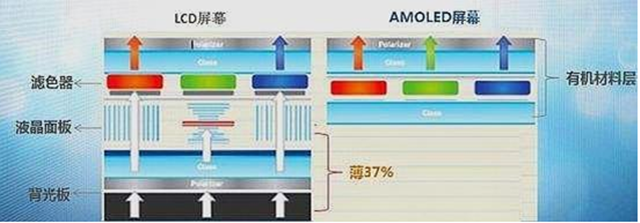
The OLED screen, also called organic light emitting diode, has the characteristics of self luminescence. It uses very thin organic coatings and glass substrates. When organic electric current passes, these organic materials will glow.

Compared with the LCD screen, OLED screen has the advantages of light weight and low power consumption, so more and more mobile phone manufacturers have introduced OLED screens in their flagship machines. For example, Apple has always insisted on LCD screen, to iPhone X, but the style suddenly changed, and OLED screen was introduced into mobile phones.
However, the OLED screen has many advantages, but there are some defects that can not be ignored, that is, "stroboscopic", "burning screen" and "partial color".
First, strobe.
In essence, the reason why the OLED screen will appear "strobe" is the principle of self display. Unlike the LCD screen, the OLED screen is illuminant by the color block itself. There is no backlight on the screen, and each pixel is illuminant independently. If the current of the access circuit is directly adjusted, the color will be interfered in the condition of low brightness, and the problems of uneven color and inaccurate color display will occur. In order to overcome these problems, many mobile phone manufacturers introduced PWM dimming on OLED screen.

The so-called PWM dimming, in simple terms, is the use of "bright, destroy, bright, destroy......" Constantly changing to change the brightness of the screen. To reduce the brightness of the screen, we only need to lengthen the interval between "bright and extinguish" alternately; on the contrary, we only need to shorten the time interval between "bright and die" alternation.
When the OLED phone screen dimming, the lower the brightness of the screen, the faster the speed of the screen will burn off. This will result in the "flickering" of the screen will be very fast in the low light environment. The environment with better lighting is good, but the problem is obvious at night and in a weak environment. Of course, even the naked eye can not be perceived, the damage to the eye is also occurring.
Two, burn screen
The so-called burn screen, popularly speaking, is actually the different parts of the OLED display, which are not synchronized with aging, resulting in partial defects on display. Since each pixel of the OLED screen is self luminous, and the time of different pixels is different, the decay rate of each pixel will be different. This is what we usually call "burning screen".

The whole screen is red.

After the iPhone X screen, the icon can no longer disappear.
Theoretically, in most cases, users usually browse different contents when using mobile phones. On average, all pixels' wear 'is basically the same. However, when users stay in the same screen for a long time, they will cause different parts of the OLED display to be worn differently.
Moreover, even the top OLED screen can not be completely avoided. For example, iPhone X used OLED screen for the first time, and soon after it was sold, it was exposed to the problem of "burning screen". Galaxy The flagship display is not uncommon.
Three, partial color
As we all know, OLED screen color display is most famous for its strong wind. At first glance, visual impact is very strong, but it is easy to produce aesthetic fatigue. The reason is that the OLED screen shows saturation and contrast generally spillover, swaying at the edge of reddish and greenish edges, not the natural color that our eyes have adapted to.

What does OLED screen phone show "colorful black"?
In addition, many manufacturers have introduced DC dimming technology in order to reduce the harm of stroboscopic. However, due to the immature technology, it is easy to have problems such as uneven illumination, color and so on, which is just like drinking poison to quench thirst, which further affects the user experience of mobile phone users.
LCD screen: less damage to eyes, mature technology development
The LCD screen is relative to the OLED screen. The so-called LCD screen is constructed by placing a liquid crystal cell in two parallel glass substrates. TFT (thin film transistor) is installed on the bottom substrate glass. Color filters are arranged on the upper substrate glass, and the direction of rotation of the liquid crystal molecules is controlled by changing the signal and voltage on the TFT, so as to achieve the purpose of controlling whether the polarized light of each pixel point is emitted or not.
Here we need to add a concept, that is, TFT. In short, TFT is to configure a semiconductor switch device for each pixel, which can directly control each pixel by point pulse. Moreover, since each node is relatively independent, it can also be controlled continuously. TFT can control various independent pixels on the screen, so that the screen information can be displayed at high speed, high brightness and high contrast.
Under normal circumstances, the reaction time of TFT is about 80 milliseconds, the visual angle can reach 130 degrees, and the advantages of TFT are also very obvious. That is, the degree of visual satisfaction can be achieved in terms of color saturation and reduction degree, and the speed of reaction is also worthy of praise.

Because the LCD screen itself has a backlight, the light is emitted from the backlight panel. Through the filter, each pixel can display red, green and blue three primary colors, and different colors can be displayed by adjusting the three primary color ratio. So using DC dimming on the LCD screen only needs to adjust the brightness of the backlight. The advantage of this is that it will not affect the display effect of color, especially the problem of stroboscopic.
The most important thing is that the LCD screen is equipped with backlight, which does not shine in itself, and is more effective in protecting human eyes.
Unfortunately, after so many years of development, although the LCD screen is more mature and reliable than the OLED screen technology development, there are fewer and fewer mobile phones equipped with LCD screens, especially the flagship models, such as apple iPhone XR, HUAWEI Mate20, and glory 20.

Through the above contents, it is easy to see that both the OLED screen and the LCD screen have their advantages and their own shortcomings, which require further technical research. We also hope that in the future, a brand new screen display technology will emerge and combine the advantages of both. Finally, it will end the debate between LCD and OLED and bring better choices to consumers.


